Chaotic pendulum
21 Jun 2026There is a particular kind of exhaustion that has nothing to do with how long you've been awake. It's the exhaustion of a body that has been pushed to do its absolute best, again and again, until even thinking starts to ache. And right behind that exhaustion, almost instantly, a verdict arrives a swing, a judgment from somewhere naming what just happened.
One voice says: it's okay. You're imperfect, and that's allowed. Look how much you've already done that's enough, more than enough.
Another voice, often borrowed from someone else's mouth, says: stop making excuses. It isn't that hard. You're just being lazy.
I've started thinking of this as a pendulum. Not a clean, gentle back-and-forth, but something with real weight and inertia something that takes force to move, and just as much force to stop. Compassion on one side. Judgment on the other. And us, somewhere in the arc between them, almost never at rest. To understand why it won't settle, it helps to look at what's actually moving.
The line, the motion, and the point that never arrives
If i try to map the mechanics of it: the motion of the pendulum is thinking. The line holding it is whatever keeps us attached to ourselves through all of this call it a lifeline. And the point of equilibrium, the place where the pendulum would actually stop swinging, is the act the doing, the finished thing, the rest.
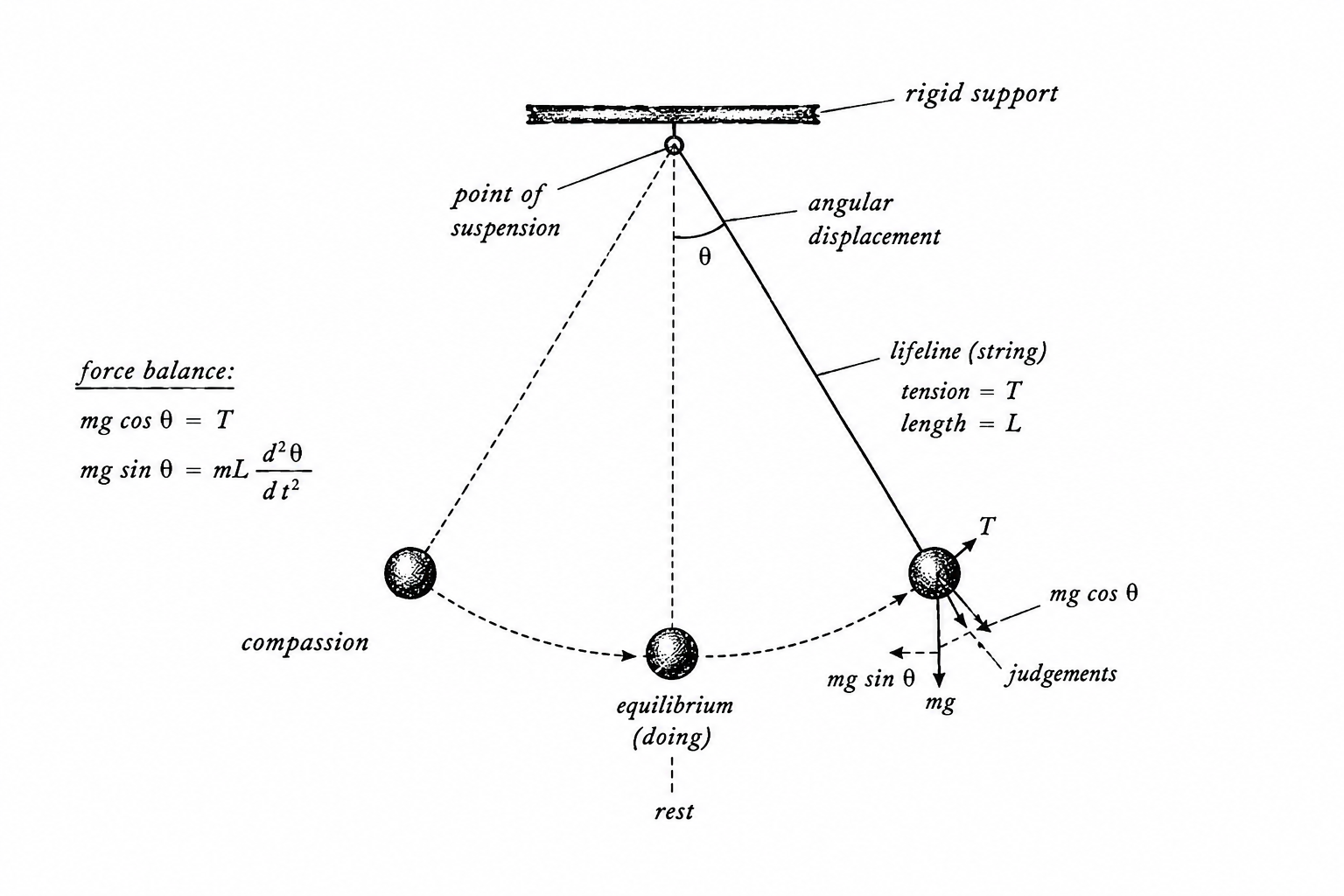
The problem is that we are, by nature, in motion. Our minds mostly don't want to stop thinking, exploring, researching, refining. They treat stillness like a threat in some cases (person). So reaching the equilibrium point landing in the act requires something that feels almost impossible: telling the thinking to stop, even for a moment, so the doing has room to happen.
This is where Zeno's old paradox keeps finding its way back into our heads. Twenty-five centuries ago, Zeno argued that a flying arrow, examined at any single instant, occupies a space exactly equal to its own length which means that, in that instant, it isn't moving at all. If every instant of the arrow's flight looks like that, made of nothing but still, motionless moments, then motion becomes an illusion stitched together out of stillness. Calculus eventually resolved this mathematically. But as a feeling, it has never gone away and we don't think it's really a paradox about arrows. It's a paradox about anyone who is always calculating the next step and never quite landing in any one of them. Each moment of thought looks like progress. The sum of all those moments can still look, from the outside, exactly like standing still.
What makes this bearable, in theory, is that the two ends of the swing are supposed to balance each other out compassion correcting judgment, judgment correcting complacency. In practice, they don't feel like opposites at all. They feel like two faces of the same demand.
Two voices, one tyranny
The psychoanalyst Karen Horney had her own name for something close to this. In Neurosis and Human Growth, she described a self split in two: an idealized self sweet, infallible, endlessly productive and a despised self, the one that surfaces every time the idealized version isn't met. She called the inner demands enforcing that split "the tyranny of the should." And she pictured the person caught inside it swinging the way a pendulum does between a perfection that was never real to begin with, and a self-hatred that feels all too real.
That's worth sitting with. The two voices described above it's okay, you're already doing great and stop being lazy, just do it aren't actually opposites. They're both shoulds. One is the should of permission, the other the should of discipline, but both are verdicts handed down by an idealized standard we're being measured against. Neither voice is asking what's actually sustainable for the person doing the swinging.
The trouble is, that standard was never just ours to set. It's borrowed, constantly, from somewhere outside us and that somewhere doesn't sit still either.
When the room itself is swinging
We used to think of the pendulum as something happening entirely inside us our own judgment, our own compassion, our own line. But the room it swings in isn't still either. Standards drift. Expectations get raised the moment they're met. And the noise of what everyone else seems to manage without visible effort gets imported wholesale into the verdict, as if it had been ours to begin with. The environment doesn't just watch the swing. It pushes on it.
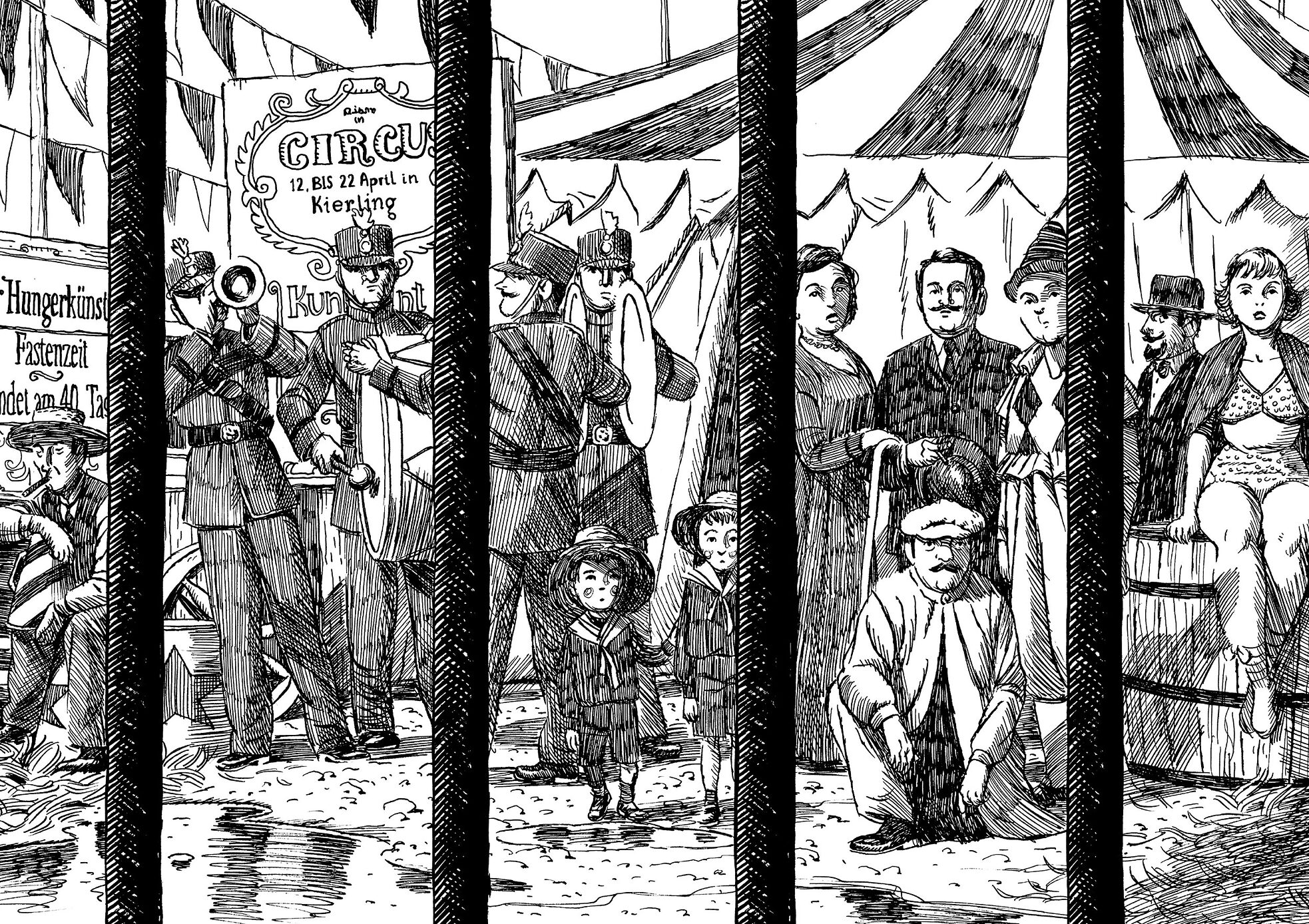
Kafka wrote a small, brutal story about exactly this kind of room. In "A Hunger Artist," a man builds his whole identity around fasting in public, inside a cage, as a kind of art. At first, the city can't get enough of him people buy season tickets, sit by the cage from morning until night. Years pass. He gets better at it. He actually succeeds in holding out longer than he ever had before, exactly as he'd hoped. But the room has moved on without telling him. No one is counting the days anymore not the crowd, not even him. He dies in that cage, mostly forgotten, and the same crowd that abandoned him gathers immediately around the panther they put there next, drawn in by an animal that does nothing but simply, vitally exist. The hunger artist wasn't cheating. He was working honestly. But, as the story puts it, the world cheated him of his reward.
That's the shape of the thing we mean by an unstable room. The hunger artist's effort kept climbing in a straight line. The audience's attention didn't follow it it followed its own restless curve, one that had very little to do with how hard he was actually working.
There's a physical version of this same room, and it's worth knowing because it's real. In 1665, Christiaan Huygens noticed that two pendulum clocks hanging on the same wall, started independently, would gradually fall into sync sometimes matching exactly, sometimes settling into perfect opposite-phase. He worked out that the swing of each pendulum was sending tiny, imperceptible movements through the wall connecting them, and those movements nudged both clocks into alignment. Centuries later, physicists confirmed he was right. Neither clock was trying to adapt. It happened automatically, just from being structurally connected to something else that was also swinging.
That's what the room actually is. Not an abstract pressure, but other people's pendulums, transmitting force through whatever wall we share with them, whether we notice it or not. And the trouble is, syncing doesn't always mean calming down. Two clocks with close enough rhythms settle into something steadier together. Two with rhythms too far apart can just as easily drag each other into something harder to predict. Trying to "be normal" is really trying to match a rhythm we can't actually hear in full we only ever catch the part of someone else's swing that surfaces in public, the steady-looking fraction, and then wonder why matching it doesn't calm anything down. We're syncing to an edited amplitude, not a real one, and calling the mismatch a personal failing.
There's a further twist researchers found when they rebuilt Huygens's experiment with modern instruments: when the two clocks do sync, the shared rhythm they settle into runs slower, and less accurately, than either clock managed on its own. Falling into step with something next to you isn't free even when it works. The very harmony that calms the swing can quietly cost you your own correctness.
This matters because of something psychology noticed over a century ago, almost by accident, while training mice to tell black from white: performance doesn't rise in a straight line with effort or pressure either. It rises, peaks, and then falls an inverted U, now known as the Yerkes-Dodson law. Push a little harder under pressure and results improve, for a while. Push past a certain point, and the same extra force buys less, not more. The relationship between how hard you're running and what you actually produce was never a straight diagonal line to begin with for the hunger artist, or for anyone watching their own effort outpace their own results.
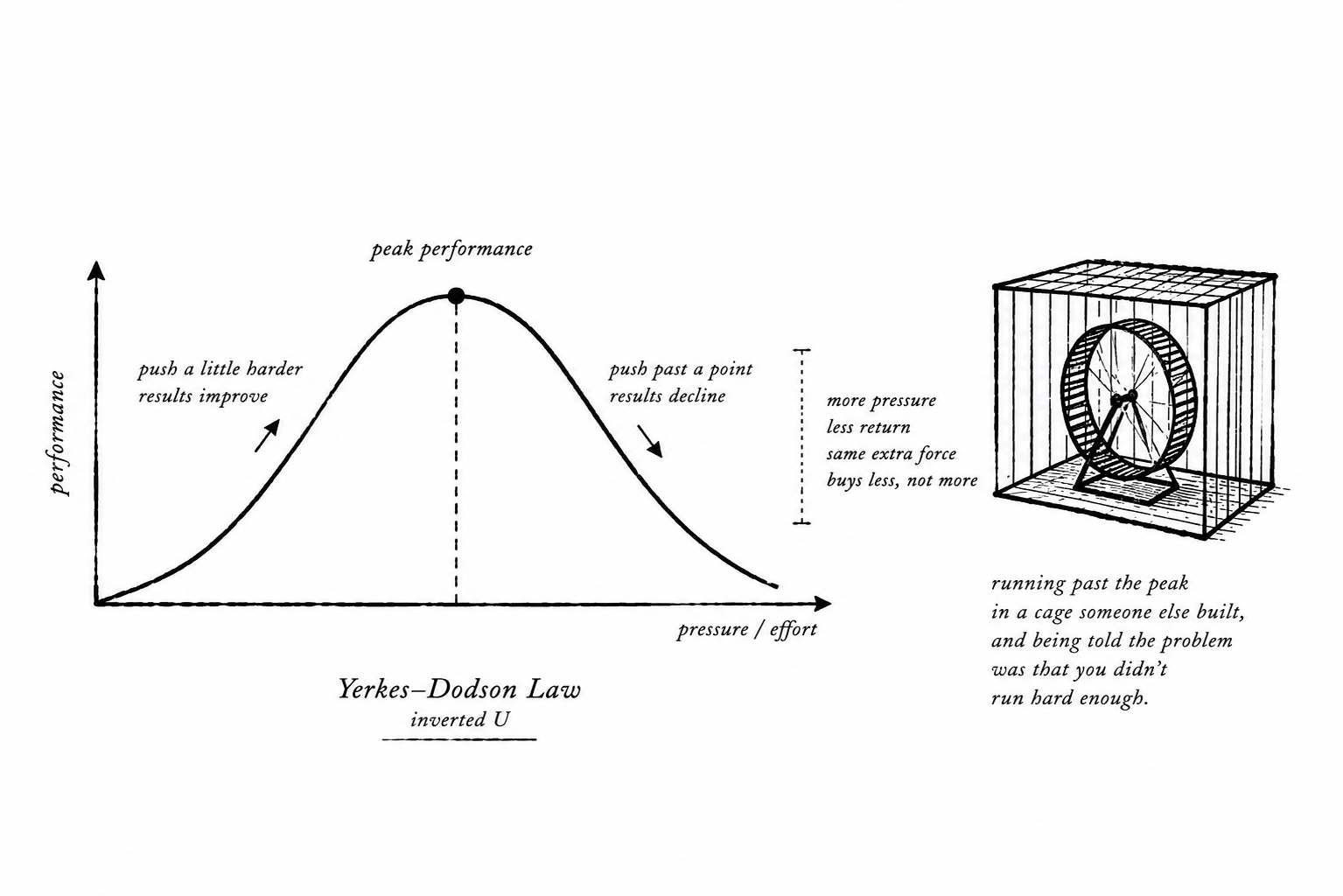
That's the quieter cruelty hiding inside "just try harder." It assumes effort and outcome are proportional that doubling the push should roughly double the result. When an unstable environment keeps dragging the bar upward anyway, demanding more output to match a result that no longer scales the way it used to, the gap between how hard it feels and how little it shows for it stops being a personal failing. It starts looking more like running past the peak of the curve, in a cage someone else built, and being told the problem was that you didn't run hard enough.
The line, then, isn't only holding against our own judgment. It's holding against a room that keeps quietly redrawing its own definition of enough which is exactly why the fix can't just be willing ourselves to push harder inside it.
Where the pendulum is allowed to slow down
We don't think the answer is choosing a side becoming permanently soft on ourselves, or permanently hard on ourselves. Both are just different ways of obeying the same idealized standard, the same tyranny of the should, just approaching from opposite directions. What we keep coming back to instead is something closer to what the psychologist Kristin Neff calls self-compassion: not self-esteem, which rises and falls with performance, but something steadier, built on three things being kind to yourself instead of harshly critical, recognizing that struggling is something every person shares rather than a private failure, and staying mindfully aware of the pain without exaggerating it or pretending it isn't there. As Neff puts it, "self-compassion is a perfect alternative to self-esteem."
That third piece, mindfulness, might be the one that actually addresses the pendulum directly. Not stopping the motion by force. Just noticing it this is the thinking again, this is the swing without immediately handing the moment over to either verdict, and without needing the room outside to agree that it's enough.
Noticing the swing is one thing, though. Living inside it, permanently, without ever expecting it to fully resolve, is another and that's the part Camus had already worked out.
The walk back down the mountain
Albert Camus, writing about a man condemned to push a boulder up a hill forever only to watch it roll back down, refused to end the story in despair. "The struggle itself toward the heights is enough to fill a man's heart." Not the arrival. Not the rock staying put at the top. The struggle itself.
We used to read that as a grim consolation prize fine, you'll never finish, so here's a trophy for the effort. Lately we read it differently. Camus was specifically arguing against the idea that recognizing a struggle as endless should make you want to escape it. His answer wasn't numbness, and it wasn't pretending the boulder was light. It was staying conscious inside the walk back down the pause between letting go of the rock and starting over and recognizing that this pause, too, belongs to you.
That's the difference between Sisyphus and the hunger artist, in the end. Both push against something that will never resolve in their favor. But Sisyphus gets to walk back down the mountain aware, present, his own while the hunger artist handed his entire sense of worth over to a room that was never going to settle the debt. The pendulum doesn't need to be stopped by cutting the line. It needs a longer, slower arc one with enough self-kindness built into the downswing that landing on the act doesn't require punishing the thinking first, and enough self-possession that the room's verdict stops being the only one that counts. Some days that will look like getting the thing done. Some days it will just look like noticing the swing, and letting that be enough for now.